June 24, 2026
From the Classroom to the TEDx Stage
At ICM, TED Talks have long been part of the classroom, used to spark discussion and help students think more deeply about the world around them. So when Dr. Peter Denton, who teaches critical thinking and philosophy, had the chance to step onto the TEDx Winnipeg stage himself, it felt like a natural next step. In his reflection, Dr. Peter Denton shares what it was like to move from showing TED Talks to students to becoming a speaker himself, along with the ideas behind his talk on technology, choice, and values.
TEDx Winnipeg: Ideas on Stage
Written by: Peter Denton, Ph.D.
When I went onstage for TEDx Winnipeg, the lights were blinding. All I could see was the red dot where I was supposed to stand. The only evidence of my audience was their applause, welcoming me to the stage.
I have used TED talks in my critical thinking philosophy course at the International College of Manitoba since I began teaching there in 2010.
TED stands for “Technology, Entertainment and Design.” Since 1990, the organization has presented annual events (archived online, beginning in 2006) of hundreds of short talks on “ideas worth spreading,” delivered from its signature large red-carpet dot in the middle of a black stage.
The TED idea itself spread quickly. Once local groups were allowed to organize TEDx events, using the same format, tens of thousands of TEDx talks, from around the world, have since been edited, curated and shared.
I was looking for short videos to promote discussion on some of the crucial issues of our time that we covered in class. These TED talks by people from all over the world have provided a diverse range of perspectives that I could never offer on my own. They also demonstrate that, regardless of age, gender or ethnicity, good ideas can come from every corner, and that every person potentially has something to share.
After using other people’s work for so long, I decided to apply to be a speaker at TEDx Winnipeg in May 2026, organized on the theme “Ingenious,” and held at the Desautels Concert Theatre at the University of Manitoba.
While the initial format limited TED talks to no more than 18 minutes, we were required instead to aim for 8 minutes. I have worked for many years on ethics and technology, so decided to tackle a recent phenomenon: “From Rocks to AI: Technology Has Always Been in Your Head.”
It was tough to work out a script that made sense, that could be memorized and rehearsed, and then delivered to my (invisible) audience.
Based on material in my latest book, The End of Technology (Kendall Hunt, 2026), I made the point that technology is in our heads, not just in our hands. Technology is never neutral or accidental. It is always intentional, because it is the product of the choices people make.
Every society since the beginning of time has developed and used their knowledge to do things. We still make choices, and our choices reflect our values, or what we think is important.
So, in the age of artificial intelligence (or AI), nothing has changed. AI is not a single thing, but actually refers to a cluster of tools – some of which are useful, and some of which are dangerous.
So, we need to think critically about what tools we use – where, when and why – and make smart technological choices that reflect what matters most to us.
As long the TED organization approves my (edited) talk, it will soon be available online for others to use and enjoy.
And, since the current TED theme is “Ideas Change Everything,” I hope that idea (and my own example) encourages my students to believe they could contribute something that the world needs to hear from some future red-carpet dot of their own.
There is always an audience, whatever we say or do, and whether we see them or not. I was thankful that mine actually laughed, as well as applauded, and hope my ideas about technology change the choices we all still make, every day.
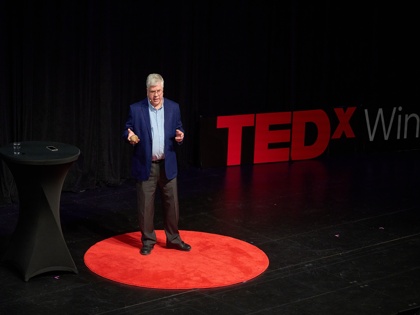
Photo taken by: Ian McAusland Photography