February 19, 2026
Rebuilding Canada’s Reputation as a Destination for Global Talent
Canada’s leaders are rightly focused on restoring public confidence in the immigration system and the need to attract top talent to build the workforce of today and tomorrow. International education remains a key source for attracting this talent. However, recent policy choices have directly impacted Canada’s global reputation as a study destination—and the signals coming back from the market have been concerning. Darcy Rollins, Head of Division for Navitas University Partnerships North America, explains why.
According to the 2025 Navitas Agent Perception Survey, only 42% of global education recruitment agents reported interest in Canada as a study destination—this is down from 86% in 2023. Agents attributed the decline to policy uncertainty, study permit delays and rejections, and perceived instability.
This shift matters because agents are a leading indicator of where interest in global education is headed. As highlighted in The Globe and Mail on Feb. 18 and 19, 2026, the survey, drawing on responses from hundreds of agents across dozens of countries, shows that students are now applying to more destinations simultaneously, with growing interest in competitor countries such as Germany, the Netherlands, the UAE, and Singapore.
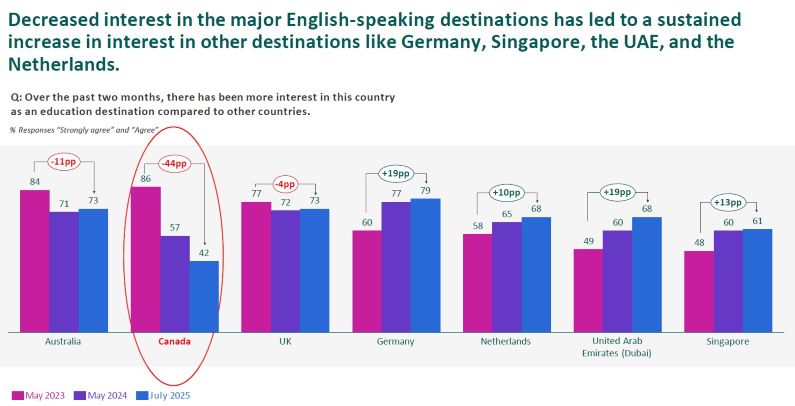
Recent Navitas Agent Perception Survey data shows declining interest in Canada (conducted with 472 agents from 28 countries in June and July 2025).
Declining interest turns out to be a bellwether for declining enrolments. As Immigration, Refugees, and Citizenship Canada (IRCC) reported on Feb. 17, 2026, Canada welcomed 61% fewer new students in 2025 compared to 2024. Prospective international students have voted with their feet and will remain wary until Canada is prepared to welcome them back.
What is most important right now is predictability. After all the changes in federal policy that international students have experienced in the past two years, they are now looking for Canada to be reliable and consistent. We have seen this happen elsewhere: where the policy environment has stabilized, sentiment towards that country has improved. Confidence rebounds when rules are clear, consistently applied, and transparently communicated.
The next step will be to ensure that approval rates and processing times for study permits and visas continue to improve. After seeing the system jam up in the past two years, Canada must continue focus on improving its services to the students it wishes to attract. Globally mobile students have many options, and they will not wait for months on end for Canada to decide if they are wanted; they will simply go elsewhere. The federal government has already acknowledged this competitive environment when it committed to two-week processing times for graduate students.
2026 marks a pivotal moment to reaffirm Canada’s position as a premier destination for international students. Achieving this will require precision in the policies that shape who we seek to attract alongside responsive programs that deliver timely visa decisions — all grounded in strong data, integrity, and coordinated action.